
Hello and welcome!
This blog serves as a space to discuss our projects and the philosophy behind them. We learn so much from the land and from community at each workday or gathering we host, and there is so much wisdom to share as we work to build resilient and regenerative community. We’ll be sharing that here.
This year we’ve been hosting ecological workdays. We study indigenous land management to inform how we work with the land. By studying and practicing these ways, we honor the land, the people who tended the land for millennia here before us, and the relationship between the people and the land. We are recognize we are not separate from the land.
Over the course of the year and several “invasive” species removal workdays, we’ve witnessed how nonnative species are an invitation into relationship with our local land; this relationship is never “over” as some will ask when the task of removing nonnatives will be finished.
These nonnative species are opportunistic. They are not evil or bad. In may ways nonnative species have provided ecological benefits in places where the native ecosystem has been broken, namely where the land has been disturbed or corrupted by extractive farming practices and development and the native seed bank has been compromised.
Indigenous cultures around the world say that the plants that are showing up are plants that are needed. For one reason or another.
An example of this could be the prevalence of Japanese Barberry, Japanese Knotweed, and Kudzu. In many places their overgrowth is concerning. Additionally a growing concern is the prevalence of Lyme’s disease spreading in our area. Each of those three plants has (researched-backed) benefits in treating Lyme’s disease once contracted.
The way we move forward with this information is to harvest the plants as we remove them, paying special attention to when in the year to harvest. Recognizing the uses of plants is incentive to harvest them from the ecosystem, and because we want to minimize their impact on the native ecosystem, we are encouraged to harvest as much as we want, as opposed to native plants which we must be very careful to harvest, if at all.
Japanese Barberry, for example, has a compound in its root called Berberine. Berberine has been called a “wonder molecule” for its “potent anti-bacterial, anti-cancer, anti-diabetic, anti-obesity, neuroprotective, anti-diarrheal , anti-inflammatory, anti-depressant, and hepatoprotective activity.”[source] This berberine can be found in our native an beloved Goldenseal. However in many places Goldenseal has been overharvested and eradicated. On the other hand, Barberry is plentiful. We are given an abundant medicine through Barberry. Let’s harvest it!
Discovering the ways to use these plants is a marvelous journey. I’ve personally been inquiring into uses for Japanese Stiltgrass for the past three years, asking dozens of ecologists and ethnobotanists, reading books and online articles. Answers have been few and far between. Marc Williams, an ethnobotanist in the Asheville area, said he’s juiced the grass to make a grass shot. Wendy Patoprsty at Blue Ridge Conservancy said “at least it’s not asphalt”. That is truly a use in itself.
We are humbled over and over by working with the land, by both its mysteries and discoveries.
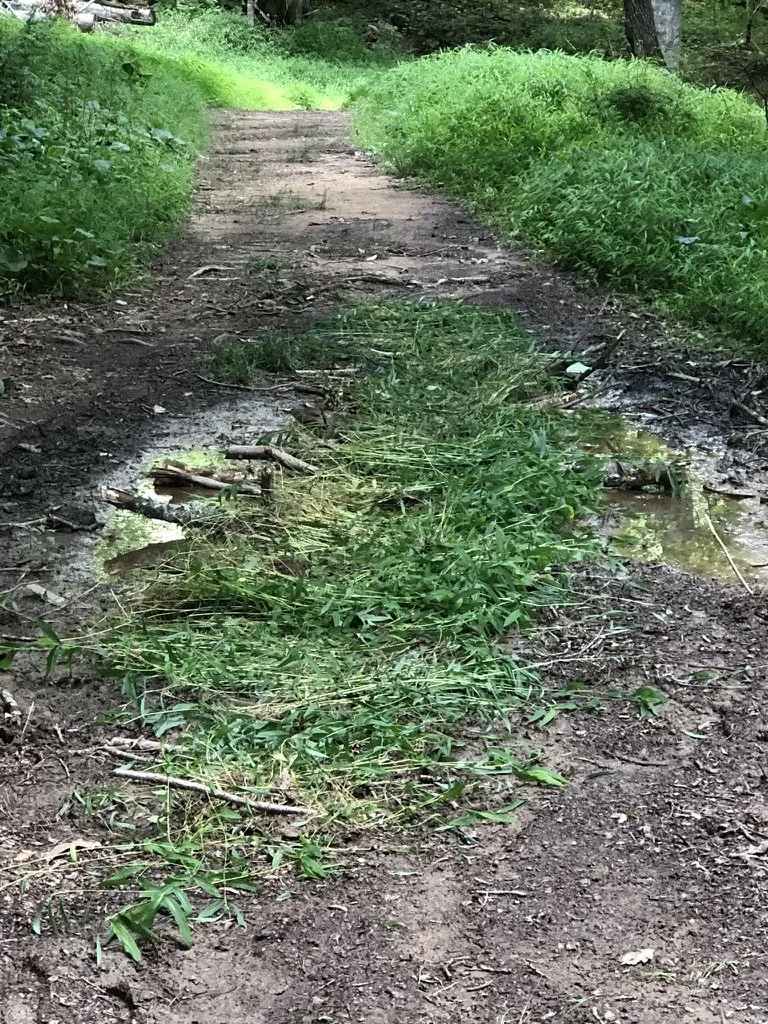
Japanese Stiltgrass lines both sides of the trail. I’ve pulled some to add vegetation to make a path through a puddle.